Blackburn Mentoring offers one-on-one executive function coaching online for teens 13 and up, college students and young adults, by video anywhere in the United States or in person in Los Angeles. Sessions work on planning the week, starting tasks, estimating time and following through, with check-ins between sessions.
Signs a student may need executive function support
An executive function mentor for teens works online with a student 13 or older on exactly these skills, inside real schoolwork. Call (888) 305-5422 to set up a free intro call.
Online executive function coaching helps teens, college students and adults build the everyday skills that turn intentions into finished work: planning the week, starting a task, estimating how long things take, tracking deadlines and following through when no one is watching. At Blackburn, sessions run by video anywhere in the United States or in person in Los Angeles, with check-ins between them.
- Assignments are done but never turned in, or turned in late
- Big projects start the night before they are due
- Grades swing from week to week with no clear reason
- A planner or app gets set up, then abandoned within a week
- Everything takes longer than expected, and the student is always surprised by it
- Homework time turns into a nightly argument at home; see homework battles with a teen
These patterns show up with and without ADHD. The executive function skills guide explains the skills in plain terms.
Quick facts: executive function coaching at Blackburn
| Who it is for | Teens 13 and up (with parents involved), college students and adults |
| Diagnosis | Not required; coaching focuses on skills and routines, not diagnosis |
| What a week includes | A planning session, a short list of tasks with times, and check-ins as deadlines come up |
| Format | One-on-one with the same dedicated mentor, by video anywhere in the United States or in person in Los Angeles |
| Between sessions | Text and phone check-ins on the steps agreed in the session |
What coaching sessions work on
- A weekly plan the student actually uses. Built in session from the real syllabus, practice schedule and job, then reviewed every week. See the weekly planner for students.
- Getting started. Breaking work into first steps small enough to begin, and tools like body doubling for the hardest tasks.
- Time. Estimating, scheduling and checking how long things really take, with strategies for time blindness.
- Follow-through between sessions. Short check-ins by text or phone on the days that matter, such as the night before a deadline.
- Self-advocacy. Emailing teachers and professors, using office hours and accommodations, and asking for help early.
What clients say
“I was taught all the life skills I never learned in school or from my family. ... To this day they are still my greatest supporters/lifelong mentors.”
“Having mentoring available for me made everything feel like I didn’t have to do anything alone.”
“From the beginning, I felt welcomed, supported, and surrounded by people who genuinely care about helping others.”
What the video shows
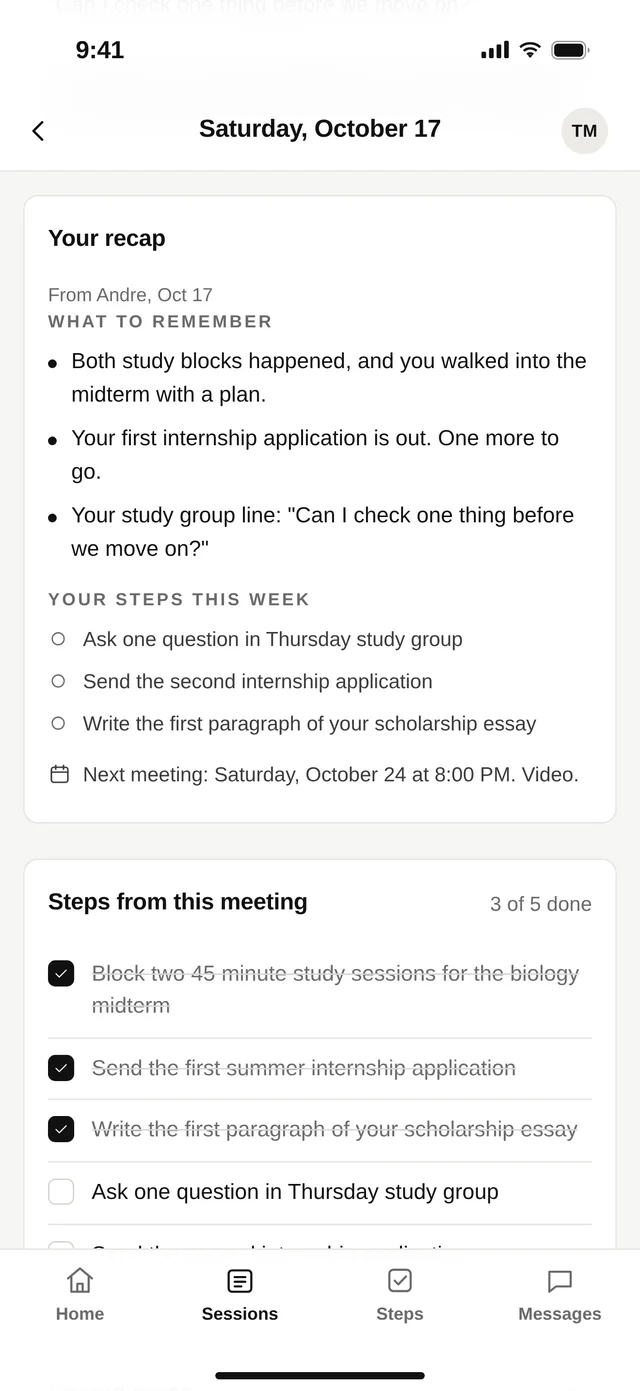
After each session the mentor shares a recap and next steps in the app. The steps get checked off during the week, and a quick midweek check-in keeps the mentor in the loop, so a week that is slipping gets noticed early.
The details
Executive function mentoring for teens online: how it works
For a teenager, executive function work is less about lectures on organization and more about practice with someone who checks in. In a weekly video session the mentor and the teen look at the coming week together, break assignments into steps with start times, and agree on two or three specific actions. Short text check-ins between sessions keep the plan alive on the days it usually falls apart.
| Skill | What a teen practices with a mentor | What to look for over time |
|---|---|---|
| Planning | Laying out the week every Sunday or Monday, with tests and long assignments broken into steps | Fewer surprises the night before a deadline |
| Starting tasks | Picking a first step small enough to start in five minutes, at a set time | Less time stuck before homework begins |
| Time estimation | Guessing how long work will take, then checking the guess | Plans that fit the hours actually available |
| Organization | One place for assignments and materials, checked at the same time each day | Fewer missing assignments |
| Self-monitoring | A quick end-of-day review: what got done, what moves to tomorrow | The teen spotting problems before a parent does |
Executive function mentoring is not tutoring in a subject and not therapy. It works alongside an ADHD evaluation, treatment or a school support plan, and a diagnosis is not required to start. For the difference between the two roles, see executive function coach vs mentor.
Coaching that fits the stage
- High school students: homework routines, grades, course load and the move toward independence, with parents involved. See mentoring for high school students.
- College students: rebuilding the structure that home and high school used to supply. See executive function coaching for college students, mentoring for college students and college with ADHD.
- Young adults and adults: work, bills, appointments and routines. See executive function coaching for adults, mentoring for adults with ADHD and executive function in adults.
Do you coach adults, or only students?
Both. Adults work on the same skills applied to work, bills, appointments and home routines. See executive function coaching for adults.
Why online coaching suits executive function work
Executive function coaching is about the systems a client uses every day: the calendar, the school portal, the email inbox, the task app and the notes on a laptop. On a video call, the mentor and client can look at those tools together with a shared screen and change them on the spot, rather than talking about them in the abstract. There is no drive to an office, so a session can sit right before homework time or right after work, when planning is most useful. Many clients also find it easier to start a hard task while their mentor is on a call with them, which is one reason body doubling works so well online. For families who move between homes, travel for sports or have a student away at college, the coaching relationship stays the same wherever the student is.
What a week of online coaching looks like
Most clients meet their mentor by video once or twice a week, at a standing time that fits school, practice or work. A session usually opens with the calendar and the school portal or task list: what was due, what got done, what slipped and why. Then the mentor and client look ahead, put every deadline in one place, break the largest task into first steps and pick the actual times those steps will happen.
Between sessions the mentor checks in by text or phone on the days that matter, such as the evening a paper is due or the morning of a hard exam. Those short check-ins are where much of the change happens, because the new habit gets practiced in real life rather than only talked about. Because it all happens online, sessions keep going through travel, sports seasons, college breaks and bad weather. Mentors are based in Los Angeles and offer early morning, evening and weekend times, so clients in Eastern, Central and Mountain time can find a slot that works in their own time zone.
How it compares to other support
A tutor teaches content, a therapist or doctor treats conditions, and a learning specialist assesses and teaches specific strategies. An executive function coach or mentor works on the daily habits that make everything else stick, and can work alongside any of them. Compare options in tutor, coach, mentor or specialist and ADHD coach vs mentor. If a student is dealing with depression, anxiety or substance use, a licensed professional is the right step. In a crisis, call or text 988.
How to start
Mentoring since 2014, it starts with a free 20 minute intro call, and new clients are matched with a mentor within 2 business days.
- Book a free intro call. A short video call with a member of our team. Calls are weekdays, 9 to 5 Pacific. Choose a time.
- Get matched. New clients are matched with a mentor within 2 business days.
- Start the plan. Sessions by video, scheduled in the student’s local time, with early morning, evening and weekend times available.
Free for iPhone and Android
How it works in the app
Book and join sessions by video
Pick a time that works and join your session from your phone.
Recaps and next steps after every session
A short summary and the steps you agreed on, waiting after each session.
Check in and message your mentor
A quick midweek check-in and a direct line between sessions.


Accountability with a real coach
How much does it cost?
We do not publish prices. See how much a mentor costs, or ask on the free intro call.
More quick facts
| Session times | Early morning, evening and weekend times, scheduled in your time zone |
| Getting started | A few quick questions online (about 2 minutes), then a free 20 minute intro call you book yourself; new clients are matched with a mentor within 2 business days |
| What it is not | Tutoring in a single subject, or therapy. Mentors work alongside a therapist only with written permission |
| Contact | (888) 305-5422 or get started online |
Questions about executive function coaching
Who offers executive function coaching for college students online?
Blackburn Mentoring offers one-on-one executive function coaching by video for college students at any school in the United States, as well as teens 13 and up and young adults. It starts with a free 20 minute intro call, and new clients are matched with a mentor within 2 business days.
Yes. Blackburn Mentoring offers executive function mentoring for teens 13 and up by video anywhere in the United States, with weekly sessions on planning, starting tasks and follow-through, and text check-ins between them. Families in Los Angeles can also meet in person. Call (888) 305-5422.
Yes. Sessions happen by video anywhere in the United States, and in person for students in Los Angeles, with text and phone check-ins between sessions.
Yes. Outside Los Angeles, all sessions are by video, scheduled in the client’s local time zone, with text and phone check-ins between sessions.
Does my child need an ADHD diagnosis to work with you?
No. Many students who struggle with planning and follow-through have no diagnosis, and many with ADHD are already working with a doctor or therapist. Mentoring focuses on the daily skills either way and does not diagnose or treat anything.
Does executive function coaching work?
Studies of coached students, mostly college students with ADHD, have found gains in study skills, organization and self-regulation, though the research is still limited. Progress is easiest to see in concrete things: fewer missing assignments, earlier starts on big projects and a weekly plan the student keeps using. See does executive function coaching work.
How involved are parents?
For high school students, parents are part of the process from the start. College students and young adults can sign up on their own, and with their permission mentors share progress updates with parents.
What is the difference between an executive function coach and a mentor?
An executive function coach focuses on specific skills such as planning, time and organization. A mentor works on those skills too, but also on motivation, routines and bigger goals such as school, work and life after high school. Many families want both in one person.
No. A tutor teaches the subject. Executive function coaching works on the skills around the subject: planning the week, starting work, estimating time, keeping track of deadlines and following through.
They overlap. Executive function coaching builds the skills (planning, starting, tracking time); accountability is the regular check-in that makes those skills stick. Blackburn mentors do both in the same sessions. See accountability coaching.
Families in Los Angeles County can read about executive function coaching in Los Angeles, where sessions happen in person in LA or by video.
Mentoring is not therapy or treatment. In a crisis, call or text 988.
Start with a free intro call
Looking for executive function support for a student? Call (888) 305-5422, email contact@blackburnmentoring.com or book a free intro call. You can also answer a few quick questions.
See available timesFree 20 minute intro call, by video. Weekdays 9 to 5 Pacific.
Not ready to book? Answer 8 quick questions
More on executive function coaching
Executive function guides
These guides go deeper on the questions families and adults ask most before starting coaching.
- What does an executive function coach do?: the skills, a sample session and how parents fit in.
- Executive function coach vs tutor: how to tell whether a student needs help with content or with planning and follow-through.
- Does executive function coaching work?: what research on coached students has found, and how to judge progress.
- Executive function coaching for college students: deadlines, starting work, accommodations and parent updates.
- Executive function coaching for adults: planning, time blindness and work routines.
- Study skills coaching and college success coaching: related coaching for students whose main need is studying or the move to college.
- How to choose an executive function coach: questions to ask and red flags.
Last updated .