Blackburn Mentoring offers one-on-one mentoring and coaching for teens 13 and up and high school students, by video anywhere in the United States and in person in Los Angeles, with one dedicated mentor who helps them get organized, motivated and more independent while parents stay in the loop. Mentoring since 2014, it starts with a free 20 minute intro call, and families are matched with a mentor within 2 business days.
High school asks a lot: harder classes, college planning, activities, social pressure and growing independence, often all at once. Mentors meet with students weekly or several times a week, with text and phone contact in between.
Blackburn Mentoring works with high school students by video in every state and in person in Los Angeles; Los Angeles families can read one-on-one mentoring for teens in Los Angeles. Call (888) 305-5422 for a free intro call.
Quick facts: mentoring for high school students
| Ages | 13 and up; for high school students, a parent or guardian is involved |
| Parent role | Joining the free intro call is optional; parents get progress updates, and what is shared depends on the teen’s age and the permissions given |
| Format | One-on-one with the same dedicated mentor, by video anywhere in the United States or in person in Los Angeles |
| Between sessions | Text and phone check-ins on the steps agreed in the session |
| Session times | Early morning, evening and weekend times, scheduled in your time zone |
| Getting started | A few quick questions online (about 2 minutes), then a free 20 minute intro call you book yourself; new clients are matched with a mentor within 2 business days |
| What it is not | Tutoring in a single subject, or therapy. Mentors work alongside a therapist only with written permission |
| Contact | (888) 305-5422 or get started online |
What high school students work on
- Organization, planners and keeping track of assignments
- Study routines and preparing for tests
- Motivation, follow-through and building confidence
- Balancing school, sports, activities and rest
- Getting ready for college: planning, applications timelines and independence
- Life skills: managing time, money, a schedule and responsibilities
- Healthy habits around sleep, screens and routines
A mentor is not a parent, and that helps
Teenagers often take the same advice better from someone who is not their parent. A mentor is an older, steady presence who the student can talk to honestly, who expects them to follow through and who celebrates progress. Parents get to step back from being the reminder, the pusher and the checker.
How parents are involved
- A parent or guardian signs up and can join the free intro call
- Goals are agreed with both the student and the parents
- Sessions are scheduled with the family, in your local time
- Parents receive regular progress updates
- Parents can reach the team with questions or concerns at any time
What mentoring is not
Mentors are not tutors, therapists or college admissions counselors. They work alongside the school, counselors and any other professionals in the student’s life. If a student is struggling with their mental health, a licensed professional is the right first step. In a crisis, call or text 988.
How to start
- Answer a few quick questions. Tell us about the student or yourself and the goals. It takes about 2 minutes.
- Book a free intro call. See a short summary of how we would approach it, then pick a time for a free 20 minute intro call.
- Meet the mentor. We match each person with a mentor whose experience and style fit.
- Start the plan. 60 minute video sessions, scheduled in your local time.
Who high school mentoring is for, and who it is not for
Mentoring tends to fit a capable student who is not yet running their own week: assignments slip through the cracks, motivation comes and goes, or a parent has become the full-time reminder. It also suits students who are doing fine but want a steadier plan for junior and senior year.
- A good fit: a student who is willing to meet, even if they are skeptical at first, and a family that wants structure rather than more pressure. See does my teenager need a mentor?
- Not the right fit on its own: a student who needs subject tutoring, a diagnosis, therapy or an admissions strategy. A mentor can work alongside those professionals, not in place of them.
What a typical week looks like
Most students meet once or twice a week by video, usually after school or on a weekend, in the family’s local time. A common pattern:
- Sunday or Monday session: look at every class, test and practice, then build the week on one page. Our weekly planner for students shows the idea.
- Midweek text: a short check on the one task most likely to slip.
- End of week: a quick review of what got done and what to carry forward, so the next session starts from facts, not guesses.
What progress tends to look like in the first months
Every student is different, so there is no set timeline, but the early months usually follow a pattern. The first few weeks are about trust and a simple routine the student will actually use. Next comes consistency: fewer missing assignments, fewer last-minute nights and less arguing at home about schoolwork. After that, the student starts planning parts of the week without prompting, and the mentor steps back. Parents see this through regular progress updates rather than by checking the grade portal every night. Related reading: teen procrastination and helping a disorganized teenager.
Mentor, tutor or executive function coach?
Families often weigh a few options at once. A tutor teaches content in one subject. An executive function coach focuses on planning and organization skills. A mentor works on the same habits but also on motivation, confidence, life skills and the bigger picture of where the student is headed. Our guides on mentor vs tutor and executive function coach vs mentor walk through the differences.
Key questions to ask any mentor or coach
- How will my teen and I know whether it is working after a couple of months?
- How often will I hear from you, and what will updates include?
- What happens between sessions if my teen misses a step?
- Who else will you coordinate with, and how?
Free for iPhone and Android
How it works in the app
Book and join sessions by video
Pick a time that works and join your session from your phone.
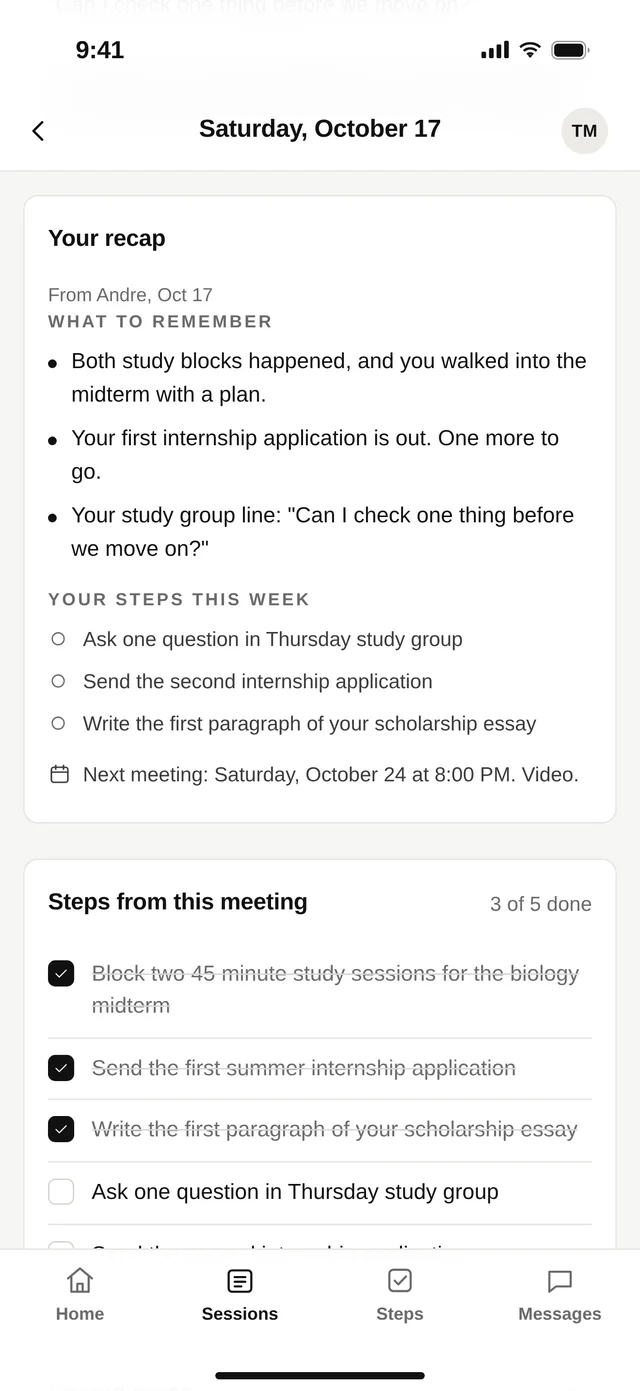
Recaps and next steps after every session
A short summary and the steps you agreed on, waiting after each session.
A read-only view for family
Parents can follow session dates and written updates from the mentor. Private notes and messages stay private.


How the parent view works
Questions about mentoring for high school students
Are parents involved?
Yes. A parent or guardian can join the intro call, agree the goals and receive regular progress updates.
Is this tutoring or college counseling?
No. Mentors focus on organization, habits, motivation and life skills, and work alongside tutors and school counselors.
What if my teen does not want a mentor?
That is common at the start. The intro call includes the student, who has a real say in the goals. Our guide on talking with a teen who will not talk may help with that first conversation.
Can a high school student work with a mentor online?
Yes. High school students can work with their Blackburn mentor by video from anywhere in the United States, with text check-ins between sessions. Families in Los Angeles can also meet in person. See online mentoring for teens.
Families in Los Angeles County can also read about a teen mentor in Los Angeles and academic coaching in Los Angeles.
In Los Angeles County, students can meet a mentor in person in Los Angeles or by video; see mentoring across Los Angeles County for your area.
In Southern California? Our school district guides explain local graduation requirements and calendars, starting with LAUSD.
How do I find a mentor for my teenager?
Start with what you want to change, then compare school and volunteer programs with paid one-on-one mentoring, and ask how goals are tracked and how parents are updated. Blackburn Mentoring offers one-on-one mentoring and coaching for teens 13 and up by video nationwide and in person in Los Angeles, starting with a free 20 minute intro call.
Related
- Mentoring for young adults after high school
- College students
- Getting ready for college
- For families
- Online mentoring nationwide
- Mentoring for Student Athletes: Training, School and Life
Get started
Looking for a mentor for a high school student? Call (888) 305-5422, email contact@blackburnmentoring.com or answer a few quick questions. It takes about 2 minutes, and you can book a free 20 minute intro call at the end.
Last updated .
Booking for a son or daughter? You can book the call yourself. Free, by video, 20 minutes, with a member of our team. Weekdays 9 to 5 Pacific.